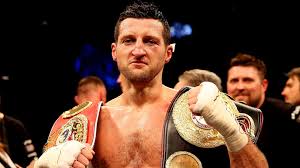
Carl Froch, ‘The Cobra’ from Nottingham, stands as one of the most compelling and divisive figures in modern British boxing history. He was a man fuelled by a seemingly inexhaustible well of self-belief, a conviction so strong it often bordered on what critics perceived as arrogance. He spoke of his granite chin, his world-class power, and his place among the elite with a certainty that was both captivating to his fans and grating to his detractors.
The ultimate question that hangs over his Hall of Fame career is a simple one, layered with complexity…. was he truly as good as he proclaimed himself to be?
His fellow pugilists often viewed him through a lens of grudging respect. They saw the technical flaws, the low-held hands, the sometimes ponderous footwork, and believed they saw a path to victory. Jermain Taylor certainly thought he had it figured out for eleven and a half rounds in their American showdown. Yet, what they also saw, and what they ultimately had to contend with, was a relentless force of nature. Andre Ward, the man who handed Froch his most definitive defeat, never downplayed The Cobra’s toughness. Ward acknowledged Froch’s immense physical strength and his unwavering will to win, even while being confident in his own superior boxing intellect and skill set. Mikkel Kessler, his great European rival, developed a relationship forged in the crucible of two epic battles. Their mutual respect was palpable; they were two warriors who knew they had faced someone of equal mettle and heart. George Groves, his final and most bitter adversary, spent years engaged in a war of words, dismissing Froch as a crude brawler. Following their two monumental clashes, that animosity softened into a recognition of the champion’s resilience and his undeniable ability to deliver under the most intense pressure imaginable. The consistent thread among his peers was an acknowledgement of his supreme toughness and his dangerous power. Few would call him a boxing purist, yet none who shared the ring with him would dare to call him anything less than a formidable world-class fighter.
The boxing world as a whole, encompassing trainers, promoters, journalists, and fans, held a similarly divided opinion. In the United States, a market that often prizes slick defensive skills and explosive athleticism, Froch was sometimes viewed as a somewhat one-dimensional, come-forward brawler. They respected his grit, particularly after the thrilling late-show knockout of Taylor, although they never quite held him in the same pound-for-pound esteem as their own champions like Andre Ward. Conversely, in the United Kingdom, he was a folk hero. His blue-collar, no-nonsense persona resonated deeply with the British public. He wasn’t a showman in the mould of a Naseem Hamed or a Tyson Fury; he was a workman who turned up, did his job with frightening intensity, and spoke his mind with unfiltered honesty. His fans loved him for his heart, his thrilling style, and his willingness to fight anyone, anywhere. They saw a throwback fighter who guaranteed excitement. The critics and boxing purists would point to his vulnerabilities, his susceptibility to a fast jab, and his reliance on that legendary chin. They argued that his style, while effective, lacked the sublime artistry of a Joe Calzaghe, the very fighter Froch chased for a career-defining domestic showdown that never materialised. Calzaghe himself was often dismissive, believing his speed and skill would have been more than enough to neutralise Froch’s power. This debate encapsulates the wider perception of Froch: a phenomenal fighter and world champion, although perhaps a step below the truly transcendent, once-in-a-generation talents.
To truly assess his quality, we should have a look at hos CV highlights. His career began its ascent to the world level with a vacant WBC super-middleweight title fight against the formidable Jean Pascal. It was a savage, twelve-round war of attrition, a phone-box brawl that set the tone for the rest of his reign. Both men stood and traded, refusing to give an inch. Froch emerged victorious, his hand raised, his face a mask of swelling and bruises, and his reputation as a man who would walk through fire firmly established. This was followed by the aforementioned trip to America to face Jermain Taylor. For much of the fight, Froch looked out of his depth. Taylor’s speed and movement were causing him fits, and he was dropped heavily in the third round. He was trailing significantly on all scorecards heading into the final round. A lesser man would have accepted defeat. Froch, however, cornered his man and unleashed a desperate, furious assault, stopping Taylor with just fourteen seconds remaining on the clock. It was a stunning display of heart and power, a victory snatched from the jaws of certain defeat. It proved his self-belief was not just talk; it was a functional weapon that allowed him to operate and succeed when conventional victory seemed impossible.
The defining period of Carl Froch’s career was undoubtedly his participation in the Super Six World Boxing Classic. This unprecedented tournament pitted six of the world’s best super-middleweights against one another in a league format, followed by knockout semi-finals and a final. It was a gauntlet that would have broken lesser fighters. His journey began with a contentious split decision victory over the slick and elusive Andre Dirrell in his hometown of Nottingham. Dirrell’s awkward style frustrated Froch, and many observers felt the American had done enough to win. This performance showcased Froch’s limitations against a pure boxer. He struggled to pin down his opponent and often looked clumsy in his pursuit. It was a win, although it was a win that raised more questions than it answered.
His next challenge took him to the hostile territory of Herning, Denmark, to face the ‘Viking Warrior’ Mikkel Kessler. In the shadow of an erupting Icelandic volcano that had grounded air travel across Europe, the two men engaged in a classic, brutal European showdown. It was an incredibly close, back-and-forth contest, a fight where every round was fiercely contested. In the end, Kessler was awarded a unanimous decision. It was Froch’s first professional defeat. He lost no shame in the loss; he had met a fellow warrior on his home turf and had come up just short in a fight of the year contender. The loss revealed a vulnerability, yet it also reinforced his reputation as a warrior who would never shy away from a challenge.
Character is often revealed not in victory, instead in the response to defeat. Froch’s response was spectacular. He faced the fearsome power-puncher Arthur Abraham, a man known for his devastating knockouts. Many expected another slugfest. Instead, Froch produced one of the most disciplined and technically astute performances of his career. He utilised his height and reach advantage, pumping out a stiff jab and controlling the distance masterfully. He gave Abraham a twelve-round boxing lesson, winning every single round on two of the judges’ scorecards. This was the fight that silenced many who claimed he was merely a brawler. He demonstrated a high boxing IQ, an ability to stick to a game plan, and the skill to completely neutralise a dangerous opponent. He followed this with a solid, workmanlike victory over the grizzled veteran Glen Johnson to book his place in the Super Six final.
In that final, he met the undefeated American prodigy, Andre Ward. This was the fight that would ultimately define the ceiling of Carl Froch’s abilities. Ward, an Olympic gold medallist, was a boxing genius, a master of controlling distance, fighting on the inside, and nullifying his opponent’s strengths. Over twelve rounds, Ward put on a clinic. He was too fast, too smart, and too skilled for the man from Nottingham. He smothered Froch’s work on the inside, beat him to the punch on the outside, and never allowed him to get his fearsome power shots off with any consistency. The defeat was comprehensive. Ward was simply the better boxer, a generational talent operating at the peak of his powers. It was Froch’s second loss, and it was a clear one. This is the primary exhibit for anyone arguing that Froch’s self-assessment was inflated. He was not the best super-middleweight in the world, because Andre Ward was.
Many careers would have tailed off after such a conclusive loss. Froch’s, remarkably, entered its most iconic phase. He returned to Nottingham for a showdown with the undefeated IBF champion Lucian Bute. Bute was a highly respected champion, and with Froch coming off the Ward loss, many had the Canadian pegged as the favourite. What transpired on that electric night was not a fight; it was a demolition. Froch, fighting like a man possessed, tore into Bute from the opening bell. He walked through Bute’s punches and returned fire with a ferocity that was terrifying to behold. He bludgeoned Bute into submission in five brutal rounds, reclaiming a world title and producing arguably the single greatest performance of his entire career. The victory was a stunning rejuvenation, a powerful statement that he remained a dominant force in the division.
With his status restored, he set his sights on revenge. The rematch with Mikkel Kessler was arranged for a sold-out O2 Arena in London. The fight was another compelling, high-stakes encounter, filled with drama and violent exchanges. This time, Froch was the stronger man down the stretch. He hurt Kessler on several occasions and boxed with a controlled aggression that showed the maturity and experience he had gained. He won a clear unanimous decision, avenging his earlier loss and unifying world titles. The victory was sweet, a testament to his resilience and his burning desire to right the wrongs on his record. He had climbed the mountain once more, defeating his great rival and cementing his position at the very top of the sport.
What followed was the final, defining chapter of his story: the two-fight saga with George Groves. The rivalry was intensely personal and captured the imagination of the British public like few before it. In their first encounter, the younger, faster Groves shocked the world by dropping Froch heavily with a booming right hand in the very first round. For the next several rounds, Groves proceeded to outbox the champion. Froch looked slow and vulnerable, a step behind his challenger. He began to claw his way back into the fight through sheer grit and pressure, yet he was still in trouble when referee Howard Foster stepped in to stop the contest in the ninth round, a decision widely seen as premature. The controversy was immense and only fuelled the demand for a rematch.
The second fight was not just a boxing match; it was a national event. It was held at Wembley Stadium in front of a post-war record crowd of 80,000 spectators. The pressure on Froch was monumental. He was the established champion, the older man, and he had a point to prove after the controversial ending of the first fight. For eight rounds, the two men engaged in a tense, tactical battle. It was a cagey affair, a high-stakes chess match with a constant undercurrent of menace. Then, in the eighth round, it happened. Froch feinted with a jab, drawing a reaction from Groves, and then unleashed a right hand of such devastating perfection that it instantly entered boxing folklore. It connected cleanly on Groves’ jaw, and the fight was over the second it landed. There was no controversy, no debate. It was a conclusive, spectacular, and iconic finish.
So, was he as good as he thought he was? The answer is not a simple yes or no. If his self-belief meant he was the most technically gifted boxer of his era, then no, he was not. Andre Ward proved that definitively. He did not possess the sublime defensive wizardry of a Floyd Mayweather or the blinding handspeed of a Roy Jones Jr. His style had its flaws, and he was hittable.
Nevertheless, if being as good as he thought he was meant being one of the toughest, most resilient, and most effective fighters of his generation with an iron will and a resume packed with elite names, then the answer is an emphatic yes. His self-belief was his greatest asset. It was the engine that drove him to get off the canvas against Taylor, to rebuild after the Kessler loss, to come back stronger after the Ward schooling, and to find that one perfect punch at Wembley. He fought Pascal, Taylor, Dirrell, Kessler twice, Abraham, Johnson, Ward, Bute, and Groves twice. It is a list of opponents that stands up to the closest scrutiny. He never ducked a challenge.
He unified world titles and retired at the pinnacle of the sport, having just delivered the most famous punch in a generation of British boxing. He may not have been a purist’s dream, yet his legacy is written not in the textbook of perfect technique, instead in the annals of unforgettable nights, epic wars, and a career built on blood, courage, and an unshakeable conviction in his own ability to find a way to win.
The 80,000 people who roared at Wembley as he stood over his vanquished rival would surely testify that, on that night and many others, Carl Froch was every bit as good as he said he was.
The Boxingmadman – follow me on X (Twitter) / Bluesky
 The Boxing Mad Man
Leave a comment